Friday, July 3, 2009

“HealthCare Remix” Discussion on Reform

Next week (July 8th, 2009), FMC Communications Director Casey Rae-Hunter will participate in a “HealthCare Remix” Discussion on Reform at the Service Employees International Union in Washington DC.

For our part of the conversation, we'll be talking about the issue of health insurance and musicians. Specifically, we'll describe the Health Insurance Navigation Tool (HINT) — a free service that provides musicians with high-quality one-on-one info about their health insurance options, from a fellow musician/health insurance expert. (HINT doesn't sell insurance or even make recommendations — it's an information resource for musicians to get a handle on what their options are).

The official media advisory is below:

“HealthCare Remix” Discussion on Reform

SEIU, Lupus Foundation for America Greater Washington, & Future of Music Coalition to hold open discussion on how individuals in the arts & beyond can benefit from reform

[Washington, DC] – In 2005, J Dilla was an influential hip-hop producer and rising artist whose promising life was cut short by complications stemming from his battle with Lupus. Without health insurance, the costs associated with his care reached triple digits. In the United States, 60% of uninsured Americans are self-employed or employed by a small business that does not offer health benefits. Please join us for a discussion on how healthcare reform can prevent the kind of financial stress and hardship the Yancey family has endured due to the high cost of medical treatment.

WHO: Mr. Malik “Phife Dawg” Taylor, member of A Tribe Called Quest & Diabetes patient; Ms. Maureen “Ma Dukes” Yancey, J Dilla’s mother; Dr. L Toni Lewis, President of Committee of Interns & Residents/SEIU; Reverend Lennox Yearwood, Hip Hop Caucus; Casey-Rae Hunter, Future of Music Coalition

WHAT: Roundtable discussion about healthcare reform and its implications for individuals in the arts and beyond.

Where: SEIU International Headquarters
1800 Massachusetts Ave, Washington, DC

When: Wednesday, July 8th 1 – 2 PM

To RSVP: Please RSVP to healthcareremix@gmail.com.

The event is planned in conjunction with the 4th Annual J Dilla Tribute & Fundraiser presented by SEIU, LFAGW & Hedrush Entertainment, hosted by Phife (ATCQ) & Grap Luva @ Liv Nightclub on Wednesday at 9 PM. Special guests include: J Dilla's mom, Ma Dukes Yancey, and his younger brother, Illa Jay. For questions or more information about the Tribute Event please call Elizabeth Muniot at 202.212.6760.

###

With 2 million members in Canada, the United States and Puerto Rico, SEIU is the fastest-growing union in the Americas. Focused on uniting workers in healthcare, public services and property services, SEIU members are winning better wages, healthcare and more secure jobs for our communities, while uniting their strength with their counterparts around the world to help ensure that workers--not just corporations and CEOs--benefit from today's global economy.

Founded in 1974, the Lupus Foundation of America Greater Washington (LFAGW) Chapter, Inc. provides free, current information, education programs and outreach services to improve the quality of lives for people with lupus while also supporting research. Toll-free number in D.C., Md., Va. and W.Va.: 1-888-349-1167 or 202-349-1167. Web site: www.lupusgw.org.

The Hip Hop Caucus, founded on September 11, 2004, has developed a 700,000 member national database, and created field teams in 48 cities across 30 states. The mission of the Hip Hop Caucus is to work towards ending urban poverty for the next generation. We organize young people in urban communities to be active in elections, policymaking, and service projects. Through Hip Hop culture, celebrities, cultural media, technology, and grassroots organizing, we reach young people of color from low-income communities, who are traditionally unengaged in the political process.

About Future of Music Coalition
Future of Music Coalition is a national non-profit education, research and advocacy organization that seeks a bright future for creators and listeners. FMC works towards this goal through continuous interaction with its primary constituency — musicians — and in collaboration with other creator/public interest groups.

Wednesday, July 1, 2009

FMC Releases New York State-Specific Playlist Study


Back in May, we told you about "Same Old Song: An Analysis of Radio Playlists in a Post FCC-Consent Decree World" — a data-driven study that analyzes radio playlists from 2005-2008 to determine whether the policy interventions resulting from the recent payola investigations have had any effect on the amount of independent music played on terrestrial radio.

You see, we wanted more than anecdotal evidence that commercial radio doesn't play much independent or local music (despite "voluntary agreements" between four major broadcasters implicated in the payola investigations and the American Association of Independent Music). "Same Old Song" examines four years of airplay – 2005-2008 – from national playlists and from seven specific music formats: AC, Urban AC, Active Rock, Country, CHR Pop, Triple A Commercial and Triple A Noncommercial. FMC calculated the “airplay share” for five different categories of record labels to determine whether the ratio of major label to non-major label airplay has changed over the past four years.

As it turns out, there hasn't really been any change in the amount of indie music on commercial radio, which seems kind of weird when you see bands like Grizzly Bear taking up the eighth slot on the Billboard Top 200. But you don't often hear even the bigger indie acts like Spoon or Arcade Fire on commercial radio, even though they're on TV and movie soundtracks and the covers of magazines (yes, those still exist), etc. Clearly there's demand for this music, so why is there so little of it on the commercial dial?

Our radio playlist studies aim to provide some insight.

Yesterday, we released a New York State-centric version of "Same Old Song," which comes to a nearly identical set of conclusions as the original report. Why did we crunch the data for NYS stations? Because that's where the whole payola investigations of the early aughts began.

In July 2005, then-New York State Attorney General Eliot Spitzer announced the results of the Office’s examination of the relationship between major labels and commercial broadcasters. “Our investigation shows that, contrary to listener expectations that songs are selected for airplay based on artistic merit and popularity, airtime is often determined by undisclosed payoffs to radio stations and their employees,” Spitzer said as he announced the findings and settlement with the record label Sony BMG. “This agreement is a model for breaking the pervasive influence of bribes in the industry,” he continued, referring to Sony BMG’s agreement to stop making payments and providing expensive gifts to radio stations and their employees in return for airplay for the company's songs. In the following months, Spitzer announced additional settlements, eventually collecting more than $35 million in fines from the four major record labels and two radio station groups.

After completing its investigations, the Attorney General’s office sent its evidence to the Federal Communications Commission. Two years later, in April 2007, the FCC issued consent decrees against the nation’s four largest radio station group owners – Clear Channel, CBS Radio, Citadel and Entercom. In addition to paying fines totaling $12.5 million, the station group owners also worked with the American Association of Independent Music (A2IM) to draft eight “Rules of Engagement” and an “indie set-aside” in which these four group owners voluntarily agreed to collectively air 4,200 hours of local, regional and unsigned artists, and artists affiliated with independent labels.

The New York State edition of "Same Old Song" focuses on playlist data from 52 music stations licensed in New York State, broadcasting in a variety of formats, from 2005-2008. Like the earlier, national study, the new report shows that independent labels — which comprise some 30 percent of the domestic music market — are left to vie for mere slivers of airtime, despite negotiated attempts to address this programming imbalance.

You can check out "Same Old Song: NYS Edition" here, in both full report and Executive Summary form.

And the original "Same Old Song" report can be viewed here.

This Week In News


ReverbNation Survey: How is the Economic Downturn Affecting Artists?
ReverbNation conducted a survey of artists in an attempt to learn how the downturn was affecting their everyday lives across a variety of factors. There was a general perception among respondents that the economic downturn was affecting them in a negative way, overall. Specifically, artists cited that they were touring less, receiving less money for gigs that have become harder to get, taking fewer lessons and turning to more DIY ways of recording their music. Hypebot.com

Pandora Changes Artist Airplay Submissions
Until recently, Pandora accepted music from indie artists at no cost in almost any form including home burned CD-R's.... Hypebot.com

Michael Jackson Breaks Billboard Charts Records
As predicted, Michael Jackson is once again the King of the Pop charts. Based on preliminary sales numbers from Nielsen SoundScan, the entire top nine positions on Billboard's Top Pop Catalog Albums chart will house Jackson-related titles when the tally is released in the early morning on Wednesday, July 1. Nielsen SoundScan's sales tracking week ended at the close of business on Sunday (June 28) night. Keith Caulfield, Billboard.Biz

Free My Phone
New mobile phones have been called “the Internet in your pocket,” but they’re not. Through exclusive deals for phones like the iPhone and BlackBerry Storm, wireless companies have curtailed innovation, crippled applications, and stuck users with the bill. Free Press

Will File Sharing Case Spawn a Copyright Reform Movement?
Last Thursday’s $1.92 million file-sharing verdict against a Minnesota mother of four could provide copyright refor advocates with a powerful human symbol of the draconian penalties written into the nearly-35 year old Copyright Act. Then again, maybe notDavid Kravets, Wired.com

Study: Twitter Users More Likely to Buy Music

Record labels looking for customers should focus their efforts on the Twitter faithful, according to new data from NPD Group. About 33 percent of Twitter users have purchased a physical CD and 34 percent have bought a digital download in the last three months, the report said. AppScout.com

Spotify Doubles Streaming Quality
Spotify, the Swedish internet radio station that allows users to stream tracks over the internet, is improving sound quality for 'Premium' users. Spotify is free to use, although listeners will find tracks peppered with adverts, just like commercial radio. However, for a £9.99 monthly subscription, users can enjoy ad-free listening. Carrie-ann Skinner, NetworkWorld.com

Tuesday, June 30, 2009

Just Plain Folks Announces JPF Music Awards Nominees


Now that we've gotten that pesky weekend out of the way, we wanted to tell you that Just Plain Folks have announced the nominees for the Just Plain Folks 2009 Music Awards.

For those unfamiliar, JPF (founded by FMC advisory board member, Brian Austin Whitney) is a website community comprising more than 51,500 songwriters, recording artists, publishers, record labels, producers and basically any other music-type, um, "folks." Their goal is simple: to help people involved in all levels of the music community network, share their experiences, build relationships and grow. JPF members have gone on to win Grammy’s, Emmys, CMA Awards and Academy Awards.

The largest independent music awards event on the planet, this year’s installment of the JPF Music Awards takes place on August 29 in Nashville, Tennessee. The 2009 “award cycle” saw submissions of more than 560,000 songs and 42,000 albums from 160-plus countries around the world. The final nominees span just about every conceivable genre —from rock, punk and country to hip hop, salsa and reggae. The awards are split into several general categories; the Founder's Awards, Song Awards, Album Awards, Video Awards, and Lyric Awards; from there the categories are then split further (although we didn’t see any emo-crunk-deathmetal-zydeco grouping).

We think the Just Plain Folks Music Awards are awesome because they help call attention to the hard work of so many independent musicians, and at an impressively wide-scale level. With extremely limited radio access and a crowded digital environment, today’s musicians have a lot of hurdles on the road to recognition, which is probably why the JPF Awards are such a hot ticket in the indie world.

Congrats to all the nominees and to JPF for all the effort they put into this event.

To check out the list of the 2009 nominees click here.

Friday, June 26, 2009

Genachowski Confirmed as FCC Chair, Starts Monday?


We're super busy on this Friday afternoon, but we wanted to get it in the official FMC record (or at least this here blog) that the Senate voted Thursday evening to confirm Julius GenachowskiPresident Barack Obama's nominee to lead the Federal Communications Commission.

Ars Technica
:

There's just one more step to go for the new boss. The White House must now formally make the Genachoswki appointment, but that's a done deal. "We expect him to be sworn in and start by Monday," an FCC spokesperson told Ars. Genachowski worked at the Commission in the 1990s as a senior advisor, then ran a variety of media ventures through the Bush years.

Genachowski and Obama go back a ways — they were Harvard classmates, and the Chief-to-be was instrumental in the Obama campaign's digital strategy. Genachowski has also worked as a venture capitalist and internet executive, so he's clearly familiar with that "series of tubes" known as the worldwide web. (Maybe he'll get 'em started on a more user-friendly FCC website?)

We're sure we'll be talking about this appointment (as well as the remaining Commission seats) in the future, but for now, we'll just say congratulations, Mr. Chairman.

Thursday, June 25, 2009

Amanda Palmer Hits Twitter Jackpot


Wow. No sooner do we report on an artist doing the DIY thing (see yesterday's piece on Erin McKeown), then we stumble across a tale that will probably go in the digital DIY storybook (not sure who publishes that).

Amanda Palmer (of Dresden Dolls and solo fame) is no stranger to the world of self-promotion and marketing. She’s also a big fan of Twitter — especially while touring — because of the direct line of communication it opens between she and her fans. Palmer has tweeted information on impromptu performances, secret gigs and press interviews that have resulted in thousands of people spontaneously turning up. Recently, Palmer took her Twitter addiction to new level and ended up netting $19,000 in a mere ten hours.

After putting out a tweet to the followers of a little subgroup she calls the Losers of Friday Night On Their Computers (Twitter hashtag #lofnotc), she soon had thousands of guests. At some point in the evening, she decided to Sharpie a t-shirt with the suggested slogan, “DON’T STAND UP FOR WHAT’S RIGHT, STAY IN FOR WHAT’S WRONG.” (Probably not presidential campaign material, but still kind of catchy.)

By the end of her anti-party (which also included comic writer/novelist/screenwriter Neil Gaiman and former teen star/geek icon Wil Wheaton), Palmer had grossed $11,000 in t-shirt sales via a hastily assembled website and PayPal. Over the next few days, Palmer pulled in an additional $8,000 from such Twitter stunts as a real-time auction and reservations to a private gig in a Boston recording studio. Total revenue for ten hours worth of tweets: $19,000.

Social technology is now a permanent part of the modern musician's arsenal. And, in some cases (like Palmer’s), it can turn into to "cash money" without the artist leaving her apartment.

You also may have heard about Palmer’s highly-public feud with her label, Roadrunner (which is distributed through Warner Music Group). It certainly could be argued that whatever investment the company made in Dresden Dolls and Palmer’s solo work had something to do with how she got those fans. Of course, compelling music and a strong live show surely played a big part.

Obviously, not every musician with a Twitter account is going to have this level of success. Still, it’s another example that a little gumption and creativity can pay dividends in the digital age.

To read more about Amanda's Twitter haul, check out her own play-by-play (via HypeBot.)

Tuesday, June 23, 2009

Erin McKeown Gets Cabin Fever in July


photo by jeff wasilko

We at FMC are always psyched when we hear about artists making DIY work for them. Although you can’t paint with one brush when it comes to musicians — many have wonderful relationships with their labels — it’s clear that today’s performers don’t need big-time backing to make a record and get it out there. And they're also getting way creative with marketing, as we point out in our recent post about Josh Freese and Jill Sobule.

Now, singer-songwriter Erin McKeown (who kicked ass at our most recent Artist Activism Camp and “Musicians Bringing Musicians Home” concert in New Orleans) is drumming up fan support to get her next record in the can and straight to her fans.

McKeown already has six albums and two EPs under her belt and has worked with über-respected artists like Ani DiFranco and Andrew Bird. For her next round of awesomeness, she’s offering fans the opportunity to watch a series of live internet concerts beginning this July called “Cabin Fever.”

The performances — which will include acoustic numbers, cover songs and an interactive, all-request electric set — will be broadcast from random places in and around Erin’s house. You know, hip venues like her living room, front porch and tour van! Proceeds from the project will go to the recording and release of her upcoming album, Hundreds of Lions, which is expected to drop later this year.

We wish Erin the best with what we think is a really cool idea. We’re also guessing that we’ll be seeing lots more of this kind of grassroots innovation from artists. That is, as long as net neutrality is preserved so that musicians have a direct connection to fans. For more information on Erin McKeown and the “Cabin Fever” project, check out her website. To learn more about how important the open internet is to artists, visit our Rock the Net page.

Monday, June 22, 2009

FMC Policy Summit: Oct. 4-6, 2009 - We want your input!


We know it’s Monday morning and everything, but we at FMC are unusually giddy. No, it’s not that triple-shot espresso — although that feels pretty good, too — we’re just excited about FMC’s 2009 Policy Summit, which takes place at Georgetown University on October 4-6.

Now, we know that’s a ways off, but you’ll definitely want to get it on your calendar. This time around, we’re inviting visionary speakers to wax philosophical about where this “music-in-the-digital-era” stuff is heading. We’re talking sky-is-the-limit, future-forward stuff, here — the kind of thing you probably won’t find at other music conferences. Of course, we’ll also be zooming up on the specific issues that impact artists and fans in a changing policy environment. And we’re currently testing some new social media tools to maximize interactivity before and during the conference. Then there’s the full day of practical, musician-oriented programming for all you real-world artists.

And we want YOUR input! We’d love it if you could spare about a minute of your time (literally, like 60 seconds) to take a five-question survey about our Policy Summit, and FMC events in general. It’s a great way for previous attendees to give feedback, and those who haven’t been to our conferences can plug in, too. Your survey answers are anonymous and confidential, but if you give us your e-mail address (don’t worry, we’re not spammers), we’ll automatically enter you into a raffle to win one complimentary registration to the event.

Remember, you can take this survey in about the amount of time it takes to figure out the next MP3 to play. (Or maybe flip the vinyl?) Head here to chime in.


Wednesday, June 17, 2009

Local Independent Promoter Sues Live Nation


A recent development in the Live Nation antitrust saga hits close to home for those living here in the District of Columbia (that’s Washington, folks). I.M.P. Inc., an independent DC/Maryland concert promotion and event production company, recently filed an antitrust suit against Live Nation. Owned by Seth Hurwitz and Rich Heinecke, I.M.P. Inc., operates the famous 9:30 Club in Washington, DC and Merriweather Post Pavilion in Columbia, Maryland.

I.M.P. claims that Live Nation has unlawfully acquired a monopoly over the national market for live music. They assert that over the years, Live Nation has acquired practically exclusive control of national concert promotions and venue services, and is now threatening to extend their control to ticketing, concert merchandising and artist management. These latter allegations seem to reference the proposed Live Nation/Ticketmaster merger currently being reviewed by the Department of Justice for possible antitrust concerns. (FMC recently asked those on both sides of the merger to give us their opinions; you can read the results here.)

According to I.M.P., Live Nation threatens to “knock Merriweather out of business or force the owners of Merriweather to engage Live Nation to manage this venue.” I.M.P. is suing for treble damages — a legal trick that would allow the court to award three times as much in damages in order to punish the Live Nation for willfully violating the law.

This suit is not Live Nation’s first brush with antitrust allegations. In 2001, Denver independent concert promoters Nobody In Particular Presents (NIPP) filed suit against radio conglomerate Clear Channel (which at that time owned Live Nation), claiming Clear Channel illegally reduced the airplay of artists that NIPP booked for their concerts. NIPP and Clear Channel settled in 2004. Now the company is back in the legal spotlight due to the proposed merger with Ticketmaster.

What do you think about the proposed Live Nation/Ticketmaster merger? Feel free to let us know in the comments.

Monday, June 15, 2009

Podcast Interview with Entertainment Attorney Josh Wattles on FMC's Artist Principles


Back in April, FMC released the "Principles for Musician Compensation in New Business Models” (or “Artist Principles”) — a set of guidelines for ensuring creator compensation in an evolving music landscape. Crafted by artist advocate Ann Chaitovitz with input from over a dozen industry experts, the Principles represent a first step in ongoing discussions about musicians’ revenue streams. You can read the document (and a handy point-by-point translation) here.

One of the main reasons for drafting this item was to get a conversation going with some of the smart people in the music world about what they think are the most important issues facing artists in the digital age. While we don’t expect these principles to be embraced by everyone, we do want to makes sure those with something to add to the discussion had a forum in which to do so.

This installment is an interview with Los Angeles-based attorney Josh Wattles, whose years in the copyright and entertainment fields have awarded him with an insider's perspective (and no shortage of opinions). Wattles talks to FMC about what he would envision in a pro-artist document, and makes some provocative statements about what the role of a record label should be in today's music marketplace.

Check out the MP3 of our conversation, and stay tuned for more podcasts in this series.

Friday, June 12, 2009

Is Radio Boycotting Artists for Their Opinions?


Earlier this week, Billboard reported that MusicFIRST — a coalition of music industry and musician union groups pushing for a public performance right for terrestrial radio — has “asked the FCC to investigate whether radio stations have violated their public interest obligation by allegedly boycotting artists who support a performance royalty for terrestrial radio.”

Without naming stations or companies, the coalition, in a 17-page Request For Declaratory Ruling filed at the commission late June 9, accuses "some broadcasters" of using their broadcast licenses "to further their financial interest at the expense of the public interest" and to "distort an important matter of public debate."

That “important matter” is the Performance Rights Act – a bill that would compensate performing artists and sound copyright owners when their music is played on over-the-air broadcasts.

In case you’re new to this issue, here’s the quick scoop (more info is available in our handy PPR fact sheet): Currently, when you hear a song on over-the-air broadcast radio in the US, the composer/songwriter/publisher are compensated for that "public performance" via ASCAP/BMI/SESAC, but the performer and record label are not. Meaning, if you hear Aretha Franklin’s classic version of "Respect" on the radio, the songwriter (in this case, Otis Redding's estate) and the publisher receive payment; the Queen of Soul (and her label) do not receive any performance royalties.

It’s important to note that when you hear the same song played on satellite radio, a webcast, or on a cable music station, Otis Redding’s estate and his publisher get their royalties from ASCAP/BMI/SESAC, and Aretha and record label are compensated via SoundExchange, the agency responsible for the collection and distribution of this digital royalty.

Although we’re not part of the MusicFIRST Coalition, FMC supports a Public Performance Right because it would directly compensate performers 45 percent of the royalties owed for the use of their music on over-the-air broadcasts. Additionally, the U.S. is one of the only industrialized nations without this right, which means American artists can't collect money owed to them for overseas spins of their music. This leaves millions on the table that would otherwise go to American performers.

Now, back to those boycott allegations. The MusicFIRST filing claims that some major broadcast group-owned stations notified a label that they were dropping a top-selling artist’s new single because that as-yet-unnamed artist had publicly voiced support of performance rights legislation. One station in Florida was singled out for allegedly telling a label it wouldn’t be adding any new music to rotation by an artist listed on the MusicFIRST website, and a Delaware station that dropped all artists associated with the coalition.

While we have no additional information regarding the veracity of these claims, we think that the FCC should take the filing seriously. Commercial broadcasters have a pretty big megaphone, and there are some examples in recent history showing that they can easily block otherwise popular artists from the airwaves. Remember when Cumulus and Cox Media instituted bans on playing Dixie Chicks’ songs on their stations after singer Natalie Maines made a statement about being “ashamed” that then-President Bush was from her home state of Texas? The First Amendment gives Maines the right to say that, and a private company (even one doing business on the public airwaves) has the right to not like it. But when this issue came up during a Senate Commerce hearing in 2003, Cumulus CEO Lew Dickey admitted that the decision to keep the Dixie Chicks off Cumulus' 50 country stations was made in the company's headquarters. The Dixie Chicks incident demonstrates that the massive consolidation in station ownership means that broadcasters can make national-level decisions about programming with potentially huge marketplace – or political – repercussions. And it can also have a chilling effect on speech.

The broadcasters’ heavy hand can also extend to musician compensation. Take, for example, the 2007 incident where Clear Channel attempted to force artists to waive their digital performance royalties (for the stations’ web streams of over-the-air content) as a consideration for airplay. FMC made a decent-sized fuss and ultimately — with the help of the American Association of Independent Music, who by the way, also support a performance right for terrestrial radio — Clear Channel ditched this onerous forced exemption.

Our point is that radio station group owners have demonstrated in the past that they the structural capacity to make programming decisions at the national level, so an artist-specific boycott is possible. We urge the FCC to follow up on these accusations and shed some light on the issue.

Thursday, June 11, 2009

Congress Tunes Into LPFM


We know we’ve talked a lot about Low Power FM (LPFM) stations lately — this is our second post this week — but that’s because there are so many exciting developments in the land of Low Power!

This morning, the House Subcommittee on Communications, Technology and the Internet held a legislative hearing on H.R. 1147, aka the Local Community Radio Act of 2009. FMC arrived at the Hill bright and early to catch all the action.

Chairman Rick Boucher gave a quick overview of the legislation and the importance of LPFM stations: “H.R. 1147, the Local Community Radio Act, introduced by Representatives Doyle and Terry, would provide additional opportunities for low-power FM (LPFM) radio stations. . . LPFM stations, which are community-based nonprofits that operate at 100 watts or less and have a broadcast reach of only a few miles, play a unique role in our media.” Well said, Mr. Chairman. As we love to point out, LPFM stations provide important, community-based alternatives to the automated voice-tracking and homogenized playlists commonly found on the commercial stations. (We've got it all in a fact sheet somewhere. . .)

Members of the subcommittee heard testimony from three different witnesses. First, Peter Doyle of the FCC (not to be confused with Representative Mike Doyle) gave the lowdown on the supposed interference problems touted by powerful commercial lobby group the National Association of Broadcasters (NAB). According to the FCC techies (and the MITRE Corp, an independent systems engineering and research org), any interference with megawatt stations is virtually non-existent. Next up, NAB board member Caroline Beasley gave her testimony opposing the bill. Finally, Cheryl Leanza of United Church of Christ gave a bold statement in support of Low Power Radio to close the hearing.

Beasley’s testimony served to highlight the fact that the NAB is only supportive of localism when it’s politically convenient. In addition to her NAB board role, Beasley is Executive Vice President and CFO of Beasley Broadcasting Group Inc., a mid-sized broadcasting company that's undoubtedly smaller than behemoth station groups like Clear Channel. It seems likely that the NAB picked Beasley to help convince the Subcommittee of its support of local-oriented radio programming. Yet this is exactly what LPFM stations deliver and what the NAB is trying to prevent by aggressively lobbying against LPFM stations in more American towns and cities.

This isn’t the first time corporate radio has sent mixed signals regarding localism. In April, we told you about Clear Channel’s contradicting press releases on localism and, recently, Billboard featured an article about how Clear Channel’s “Premium Choice” initiative emphasizes prerecorded programming over local programming.

The Subcommittee, by and large, did not take the NAB’s bait. Several representatives fired questions at Beasley, some of which she was unable to answer. When Rep. Cliff Stearns asked, “why does the NAB dispute the FCC report [showing that LPFM stations cause no significant interference problems]?”, all Beasley had to say was, “We do. We are on record as disputing the report.” Talk about evasive maneuvers.

Leanza demonstrated the important role LPFM stations play in local communities, while Doyle confirmed that they pose no interference threat to full-power stations. Both of their testimonies were packed with data and examples of the unmet demand for community radio and the immense programming possibilities that would be created by lifting the unnecessary restrictions on LPFM radio. “As I have worked on this issue over the years,” said Leanza, “one of my favorite moments is after I ask someone the question, ‘what would a radio station sound like if you and your community ran it?’ All of a sudden a person’s eyes light up as they start to imagine what they could do. It is a wonderful experience to see the wheels start turning in people’s heads. “

You can read the full testimonies here.

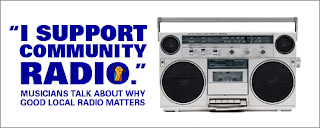
Yesterday, we told you about our brand-spanking-new “I Support Community Radio” campaign, which features established and emerging musicians talking about how local radio has positively impacted their lives — both as artists and listeners. Head here to check out video testimonials from such artists as the Indigo Girls, Saul Williams, David Harrington of Kronos Quartet, Jon Langford of The Mekons and Waco Brothers, Vijay Iyer, Franz Nicolay of The Hold Steady and more. And in their own words, no less!

Now that the hearing is over, Congress will be deciding whether or not to enact the Local Community Radio Act of 2009. Musicians: one way to have your voice heard is to create your own video about what good local radio means to you. E-mail casey@futureofmusic.org to learn how to submit a clip. Oh, and Low Power to the People!

Wednesday, June 10, 2009

"I Support Community Radio" = Artist Video Testimonials


When was the last time you cranked up the volume on your radio because you heard something new, different or local? Chances are it's been a while. But quality local broadcasting doesn't have to be a thing of the past. Together, we can make it an everyday reality.

Radio is still an incredibly important resource for artists, fans and communities. That's why FMC is involved in the fight to expand non-commercial radio as alternatives to homogenized commercial broadcasting. We believe that radio has the power to inspire, inform and entertain while serving up distinct local and regional flavor. And the musicians we've talked to think so, too.

That's why we're psyched to unveil our "I Support Community Radio" campaign, which features videos of artists talking in their own words about why good local radio is so important. We've got some awesome artists on board so far — Saul Williams, the Indigo Girls, Kronos Quartet, Franz Nicolay of The Hold Steady, Girl in a Coma and Jon Langford — with more on the way. (Interested in being a part of this project? Send an e-mail to casey@futureofmusic.org for details on how to submit your own video testimonial.)

One way to put the community back in radio is to lift the unnecessary restrictions on Low Power FM stations in larger American towns and cities. Low Power FM stations are community-based, non-commercial radio broadcasters that operate at 100 watts or less and reach a radius of 3 to 7 miles. LPFM provides a platform for underserved musical genres, minority, religious and linguistic groups and offers a forum for debate about important local issues. (For more info, check out our fact sheet).

The FCC has long supported expanding LPFM, but earlier in the decade, the National Association of Broadcasters (NAB) – who represent commercial radio interests – successfully lobbied Congress to limit LPFM stations to a mere fraction of the number originally proposed by the FCC.

An independent FCC-commissioned study completed in 2003 found no significant interference would be caused by LPFM — we think it's high time for the government to recognize the important role these stations could play in local communities. And it's looking like they finally might — LPFM has strong bipartisan support in Congress, with the Local Community Radio Act (HR 1147 / S 592) serving as the legislative vehicle to get the airwaves primed for low-power.

The Subcommittee on Communications, Technology, and the Internet will hold a legislative hearing on H.R. 1147, the Local Community Radio Act of 2009, H.R. 1133, the Family Telephone Connection Protection Act of 2009, and H.R. 1084, the Commercial Advertisement Loudness Mitigation Act (CALM Act) on Thursday, June 11, 2009, in 2322 Rayburn House Office Building.

Hey, that's tomorrow!

We'll be attending the hearing and will let you know what goes down. In the meantime, check out those artist videos!

Tuesday, June 9, 2009

SXSW 2010 Wants To Hear Your Voice!


If you caught the music panels at SXSW 2009, you probably witnessed some pretty interesting stuff (especially those FMC speakers). But maybe there was a topic or issue you think was overlooked. Well, now you can have a hand in next year’s programming! SXSW recently launched its 2010 “Panel Picker” interface — an online system that allows the SXSW community to weigh in on what they’d like to see disussed at the 2010 event in Austin, TX.

SXSW is encouraging anyone with an awesome idea for a panel or presentation for either the music, interactive or film events to submit their proposals (a maximum of two per person) online for consideration from now until July 10.

The voting process begins on August 10, and lets you, the web community (along with the SXSW staff and advisory board) to voice your opinions as to what will be presented at SXSW ‘10. If you don’t have specific suggestions, you can still be a part of the selection committee, by browsing through a list of options and voting for what you’d like to see (public voting will count for 30% of the decision making process). Click here for more information on how to plug in.

This is the first year that SXSW has expanded its Panel Picker program to the music community, so we’re guessing that next year’s discussions could get even more interesting. And of course, we’ll keep you posted on any FMC action at SXSW. . .


Monday, June 8, 2009

FMC seeks Website Project Manager/Graphic Designer


Future of Music Coalition seeks a freelance, part-time graphic designer and website project manager for our conference in October 4-6, 2009

Responsibilities include:

Website- building/troubleshooting new website functionality using drupal- maintaining content on new event website using web-based CMS

Graphic Design - designing handbills, posters, banners, signs, event program and other necessary print pieces for the event- resizing existing web graphics on an as-needed basis

QUALIFICATIONS - Knowledge of QuarkExpress/InDesign, Illustrator, Photoshop- Drupal coding experience necessary- Good design eye (font or color doesn't match, that's not consistent with the other postcard, we forgot to update the time/prices, etc)- Project management experience, good with follow through/follow up- Creative problem solver/troubleshooter- Flexible, organized, detail-oriented individual who can work independently- Skilled at managing people and expectations- Telecommuting is totally cool- We're a mac office FYI

COMPENSATION - Compensation will be commensurate with experience.

TIMELINE- Event is Oct 4-6, 2009. You will need to be available June-October on as needed basis. The bulk of the work would probably happen in June/early July and September.

TO APPLYPlease send cover letter, resume and links to work samples to jobs@futureofmusic.org. Position is open until filled.

Friday, June 5, 2009

Good News for Low Power FM!

Not only is it Friday (woohoo — the weekend!), but here at FMC we just got word that the U.S. Court of Appeals for the DC Circuit issued an important decision in support of Low Power FM radio. (Click here for the full PDF of the ruling.)

Just to catch up, LPFM stations are community-based, non-commercial radio broadcasters that operate at 100 watts or less and reach a radius of 3 to 7 miles. LPFM provides a platform for underserved musical genres, minority, religious and linguistic groups and offers a forum for debate about important local issues. LPFM also has a crucial role to play in disseminating public information for the welfare and safety of local communities. Did we mention that it’s great for local artists who rarely have a shot at getting airplay on their local commercial station?

If LPFM is so great (and it is), why don’t we have more stations like this? Well, earlier in the decade, the National Association of Broadcasters (NAB) – who represent commercial radio interests – successfully lobbied Congress to restrict LPFM stations to smaller communities, claiming that these stations’ tiny signals would cause “oceans of interference” with their own megawatt stations. These restrictions were embodied in the Radio Broadcasting Preservation Act of 2000. The Act limits community organizations’ ability to get LPFM licenses, and makes LPFMs secondary to full power stations. This means they are subject to getting knocked off the air if a full power station moves into the LPFM’s community.

In December 2007, the FCC revised some of it rules and policies in order to protect LPFMs from full-power FM stations that encroach onto the space currently occupied by existing LPFMs. The NAB filed a petition for review of these modifications, claiming they reduce the protections afforded to full power stations and violate the Radio Broadcast Preservation Act.

In a small, but decisive victory for existing LPFM stations, the U.S. Court of Appeals, DC Circuit dismissed the NAB’s petition for review and upheld the FCC’s December 2007 decision to protect LPFM stations. The DC Circuit held that the Radio Broadcast Preservation Act of 2000 did not prevent the FCC from taking measures to protect LPFM stations. Therefore, the FCC’s decision to modify its regulations to protect LPFM stations from encroachment by full-power stations was well within their authority. As the FCC has been a long-time supporter of LPFM, it’s great to have confirmation that the Commission can make decisions about how to protect these small but important broadcasters.

Now for some of that exciting legal detail. We completely understand if you wanna skip this section, but the Court’s ruling has some interesting aspects, so here ya go:

In their petition, the NAB also claimed that part of the FCC’s revised rules would result in the Commission “regulating content.” Here’s the background to their claim: the 2007 FCC modifications established a “presumption” in favor of LPFM stations when a new, full-power FM station and an existing LPFM station begin broadcasting too close to one another in violation of FCC minimum distance requirements (the space between stations that limits signal interference). Essentially, if the existing LPFM station has nowhere to move, but regularly provides “at least eight hours per day of locally originated programming,” the FCC will presume the public interest favors the LPFM station, and will not shut it down. The new, full-power FM station, however, is free to rebut this presumption.

The NAB claims that this presumption allows the FCC to regulate content by favoring local-oriented content over national-oriented content. The DC Circuit held that the FCC presumption in favor of “locally originated programming” is not equivalent to content-based regulation. In the absence of any other evidence from the NAB that the FCC would use the presumption to control content, the court said this issue was “unripe,” which is an odd little legal term that might as well mean “undercooked.”

Overall, the District Court’s decision was a strong one in favor of LPFM. Hopefully it will provide some incentive for Congress to adopt the Local Community Radio Act of 2009, which will be heard by the House Communications, Technology and Internet Subcommittee on June 11. We'll be there to report on the proceedings, so stay tuned. . .

Thursday, June 4, 2009

Chart Attack: Who’s “Indie” When it Comes to Sales?

Digital Music News recently ran an article called “The Gray Art of Counting Indie Sales,” which underlined the confusion of tallying purchases of downloads or CDs based on the music’s “independent” classification. According to the American Association of Independent Music (A2IM), 32 percent of album sales in 2008 came from independent artists, but Nielsen Soundscan puts that number at 12.8 percent. Part of the difficulty in differentiating between an indie and a major the fact that many indie labels enter deals with distribution companies owned by the majors, such as ADA (95% owned by Warner) or Fontana (owned by Universal). As a result, major labels have a tendency “count the sales of their distributed partners, while indies like to downplay those partnerships,” according to DMN publisher Paul Resnikoff.

According to the American Association of Independent Music (A2IM), everything is tallied according to IP ownership — in other words, who owns the masters. "What makes a label an “indie'” is that its master recordings are not owned by one of the major labels," the group stated.

A2IM president Rich Bengloff tipped Digital Music News to that distinction earlier this year. "I think if you asked the man on the street they would go with the ownership criteria because it's permanent," Bengloff said.

FMC has had its own experience with trying to figure out what constitutes an indie or a major label. Over the last year, FMC has conducted research on radio playlists, released last month in the report “Same Old Song.” Since the research was designed to measure the difference in “airplay share” for songs released by major labels versus non-major labels, the backbone of the work was coding all of the labels that received any airplay between 2005 and 2008. When we extracted that list, there were over 6,000 unique record labels that received some airplay.

We ended up having 5 different codes:

• Major: the four majors and any of their many-owned subsidiaries and imprints

• Indie: Following A2IM’s lead, we considered an indie label as one independently owned/that controls its own masters and seems to be responsible for its own radio promotion. Even if the indie label had a distribution deal, we classified them as “indies” since distro deals usually focus on getting songs into retail as opposed to getting airplay on radio.

• Disney: including its imprints Lyric Street, Fearless and Hollywood Records. After completing some early data analysis we discovered it was important to give Disney its own code since, in some formats, this one label or its subsidiaries was garnering 2-3% of total airplay. In essence, Disney has the strength of a major label, but was not part of the payola proceedings and thus needed its own category to isolate its level of influence.

• Legacy: A small set of labels or well-known artists for which their relationships to the major labels has either changed over time, or for which a major label association with radio is likely, but cannot be confirmed. Example: recent releases by The Eagles, Jimmy Buffett, Cheap Trick or Motley Crue: artists who are now putting out their own music, but who have a well-documented history of significant radio airplay while on a major label in the past. There are also some current labels in this pool, such as Tooth and Nail, that started as an indie in the 1990s, but has allegedly created a number of upstreaming deals with major labels. This is also where we put companies like Mountain Dew’s Green Label Sound, which has been releasing singles to promote the soft drink. Clearly, this is a company with a significant promotional budget, but it’s not a major label. Without additional information it was difficult to categorize them as an indie or a major.

• No label/TBD: in the cases where there was insufficient data

Even with these five categories, we had to make many judgment calls. There were cases where a label’s relationship to various major labels had changed over the years. For example, Roadrunner started as an independent but as of January 2007 is now 74 percent owned by Warner Brothers. There are other labels that have a documented upstreaming deal with the majors – such as Fall Out Boy’s label Decaydance, which has a relationship with Island – where the independent label finds a band, puts out their first record and then the major label partner can come in and sign them to a bigger deal. On the charts, if the song had a listing Decayadance, we’d code it as an indie. If it said Decaydance/Island, we classified it as a major. In cases where we could not determine with certainty, we erred on the side of independence. Needless to say, defining “indie market share” is an inexact science, and an ever-evolving landscape.

But what about unaffiliated artists who aren’t on a label – indie or otherwise? We’ve talked recently about services like TuneCore, CD Baby and ReverbNation, which, for a nominal fee, get unsigned artists “stocked” at digital retailers like iTunes, eMusic, Amazon MP3, Rhapsody, Napster and so forth. If an unaffiliated act starts “moving serious units,” to use Music Industry 1.0 lingo, how do they demonstrate this success to the wider world? For this, you probably need some kind of ranking system that the industry (and fans) perceive as legitimate.

TuneCore currently has a chart in Billboard showcasing the 25 top-selling artists who use their service. (This chart displays two types of data: top selling full albums by total earnings for the period and top selling individual songs by earnings for the period.) Appearing in Billboard would do more than make your mom proud — it actually means something to the industry. But since established mainstream artists also use TuneCore, the top spots are often already filled. For instance, Jay Z, David Byrne, Joan Jett and t.A.T.u are all currently featured on TuneCore’s March 2009 album list (as reported in May 2009). That’s some stiff competition. (Click here for a look at the most recent charts.)

Digital distributor/marketing tool ReverbNation also has charts to show which of its artists are selling the most. But unlike TuneCore’s Billboard chart, which lumps all musicians irrespective of genre into a single top 25 listing, ReverbNation breaks its lists down by not only style of music, but also by location. You can find the top selling albums/songs from musicians from US or even the world,, including your own backyard. (Similarly, TuneCore’s iPhone app uses a geolocator that tells you the 25 best selling TuneCore songs based on your exact zip code.)

Keep in mind that all of this is based on downloads. While digital sales might currently be a better indicator of “success” than MySpace plays, there isn’t (to our knowledge) a chart that measures on-demand listens where you don’t keep the digital file. As people grow more accustomed to “accessing” music as opposed to owning it, accounting for online plays could become increasingly important.

As more artists go direct to fans and label roles evolve, all of this gets a bit fuzzier. Will everyone eventually be wading in the same digital pool? Do standard chart measurements even apply in a world of limited-edition physical items, on-demand streams and (potentially) legal filesharing?

For a lot of musicians, having people at your shows and moving some merch is achievement enough. But we’re curious: what do you think counts as success with recorded music? Feel free to let us know in the comments.

Tuesday, June 2, 2009

This Week In News


Sony Agrees to Provide Its Older Songs to eMusic
In another example of struggling major music labels and Internet services finding common ground, Sony Music Entertainment has agreed to make its back catalog of songs available on eMusic, one of the largest music retailers on the Web. Brad Stone, The New York Times


Live Nation to Rollout ‘No Service Fee’ Promotion
Live Nation will eliminate service fees on more than five million lawn tickets and hundreds of concerts for its amphitheaters in a one-day promotion June 3. The 24-hour sales event is being billed as the biggest ticket promotion ever, which would be hard to dispute. "No Service Fee Wednesdays," begins June 3 at 12:01 a.m., offering fans some of the lowest prices of the summer with no ticket service fees on any LiveNation.com-ticketed amphitheater show, and only at LiveNation.com. Ray Waddell, Billboard.Biz


Web Radio Hits the Road
It took a long drive over a holiday weekend -- a setting that should have played to all of radio's traditional strengths-- to show how much trouble commercial FM stations may have in store. The soundtrack for the trip along Interstates 66 and 81 to the Shenandoah Valley town of Woodstock, Va., came not from FM, an XM or Sirius satellite broadcast or such recorded alternatives as CD or iPod. Instead, our musical selection came from an Internet-connected smartphone that streamed Web radio to the nearest speakers through a cheap tape-deck adapter. Rob Pegoraro, The Washington Post


Walmart Shutting Down DRM Download Servers
Walmart.com's music download store went DRM free in February of 2008; and now the retail giant is telling customers that they'll no longer support the DRM laden downloads that they sold them prior to the transition. Hypebot.com


This Just In: Old People Hate New Music
… E Street Band guitarist “Little” Steven Van Zandt is citing the sucktitude of today’s rock ‘n’ roll as the reason the record industry is sinking faster than the Lusitania (“Who are we kidding here? Nobody’s buying records? Because they suck!”). Modern rock’s suckiness, the apparently computer-illiterate Van Zandt claims, can be traced to the fact that this generation’s musicians are eschewing the time-honored tradition of playing cover songs in bars (so’s they can focus on original material, the bastards!) and ignoring the importance of ripping off the popular rockers who came before them. James Greene Jr, Crawdaddy.wolfgangsvault.com


Billboard.biz Q&A: Former RIAA CEO Rosen Talks Napster
When Napster first went live 10 years ago this month, the music industry didn't immediately notice. It wasn't until around September 1999 that the RIAA got wise, and not until December that a lawsuit was filed. Leading the organization at that time was Hilary Rosen, who presided over the case that shut down Napster and all the music industry moves that followed until she resigned in 2003. Anthony Bruno, Billboard.biz

Friday, May 29, 2009

Is "Cloud" Music Becoming a Reality?


Digital Music News ran a short item today about Spotify — a fast-growing free/subscription streaming service that's available overseas but not yet in the US. The article is about a demo of an upcoming app for Google's Android cellphone platform:

An Android mobile app was splashed at the Google I/O conference in San Francisco, a work-in-progress that quickly excited music fans and bloggers alike. As one would expect, the app demo featured on-demand access to a catalog of millions, using available WiFi. But users will also be able to access tracks while disconnected, a feature that eliminates a huge connectivity hurdle.

There's also a YouTube clip of a similar Spotify app for iPhone, which, to the best of our knowledge, has yet to be approved by Apple. If anything could compete with iTunes, it's Spotify, so it will be interesting to see if an iPhone app does indeed roll out with a Spotify US launch (rumored to happen later this year).

Although it's not officially available in the US, Spotify is starting to win converts among American music reporters and pundits. Wired's Eliot Van Buskirk says the service is “like a magical version of iTunes in which you’ve already bought every song in the world," and industry observer Bob Lefsetz has been moved to praise Spotify IN ALL CAPS on more than one occasion.

There are probably several reasons for Spotify's rapid adoption in countries like the UK, where it's been available for a year or so. The graphic interface is straightforward (and very iTunes-like), and, since it employs a robust desktop client, there is practically zero lag (yes, we've tested this.) Spotify also uses the superior Ogg Vorbis format for its streams, which means it actually sounds good. Perhaps most attractive is the fact that the service is free — as long as you don’t mind hearing a solitary audio ad every half-hour or so (there's also a paid version without the ads). This means that artists and sound copyright owners are compensated, which we think is top priority for any new digital music doohickey.

Keep in mind that Spotify is on-demand listening, not "predictive radio" like Pandora (which is also gaining popularity, largely due to mobile applications).

Music-tech analyst Andrew Dubber gives a useful overview of Spotify, which you can read here. Among his favorite features:

. . .every artist, every album and every track has a unique URL that can be sent via email, Twitter, IM, Facebook or any other kind of messaging system - and if the recipient also has Spotify installed, that music will play in exactly the same way it did for the person sending it.

Recently, Andrew made a recommendation via his Twitter feed; if you're a Spotify user, you could click the link and the album he was talking about immediately pops up and starts playing on your end. With the ubiquity of social media, it’s easy to imagine this becoming a powerful, cost-effective and legal way to share music.

Some have complained that Spotify, while rock-solid performance-wise, is lacking some essential features. On the other hand, the Spotify folks have opened their service to outside development, which likely means enhancements are forthcoming. Essentially, approved third-party devices and services would be able to use Spotify’s engine and catalog, which could be particularly fruitful in the mobile space.

There are also concerns that subscription and ad-based models don't pay artists and labels as much per play as downloads of physical sales. But that could change, especially if more people get hooked on listening this way. It could also help curb piracy — why take the chance on viruses and music in crappy bitrates, when you can get better quality tunes for "free" (or at a nominal cost)?

The idea of being able to listen to practically everything you'd ever want to whenever you want to isn't new. But American consumers haven't fully embraced such services, even with Rhapsody, Napster, etc. offering some version of subscription-based access. Will Spotify be the model that makes "the cloud" click? Only time will tell. . .

Wednesday, May 27, 2009

Back From New Orleans!


FMC's Jean Cook and Jon Langford rock New Orleans

Our three-day bacchanal in the Big Easy (a highly productive bacchanal, we might add) has ended, and FMC staff are back in D.C., where we're basking in the warm memories of another successful Artist Activism Camp and "Musicians Bringing Musicians Home" concert. Bet you wish you had been there! Well, maybe you were. . . if so, cheers!

This year's retreat included such talented artists as Wayne Kramer (MC5), Jolie Holland, Jon Langford (Waco Brothers, Mekons), Saul Williams, Scott McCaughey (Young Fresh Fellows, Minus 5, R.E.M.), Laura Veirs, Vijay Iyer, Erin McKeown, Bonerama, Al “Carnival Time” Johnson, Martín Perna (Antibalas, TV On the Radio, Ocote Soul Sounds), Mariam Adam (Imani Winds), Luke Reynolds (Pictures and Sounds) and Paul Sanchez.

These musicians joined organizers FMC and Air Traffic Control in New Orleans to participate in strategy sessions about how to integrate activism and philanthropy into their musical lives and careers. They also took the time to tour local neighborhoods and visit with the city’s notable musicians and community leaders.

Then there was the concert, which was a doozy. The all-star show took place on May 22 at Tipitina’s Uptown and benefited Sweet Home New Orleans — a non-profit organization that provides social services and economic development programs to musicians, Mardi Gras Indians, and other traditional New Orleans artists affected by Katrina.

Check out our Events Coordinator Chhaya Kapadia's Flickr stream for a birdseye view of the action. Rumor has it the great Jon Langford was also prowling around with a flipcam; we'll post that video as soon as we determine its suitability for public consumption.

You should also have a look at Chhaya's post on her own blog about her experiences in New Orleans. She's a true Artist Activism Camp veteran (or "Carnival Timers," as participants call each other), with five retreats and concerts under her belt. Hot damn!